søndag 6. august 2017

A few kilos off

Hard to get them off; even harder to keep them away...

I have been wanting to write this post since March, but I waited until now to make sure the kilos would stay away. During January and February this winter I made a serious effort and lost 6 kilos. Several friends have asked for the recipe and I promised that it would come. You might remember that I have a history of overweight, and I have to constantly watch what I eat, although i train several hours per day, in average.
At the time I lost the big weight all those years ago, I was told that it would take the body a couple of years to get used to the new weight. During this time the body would all the time try to get back to the same high weight again, so one had to be extra careful. Unfortunately, new research indicates that this period is much longer than two years. In fact, if the overweight lasted over a longer time, the body might try to get back to that weigh for many years, perhaps the rest of its life... Many of my friends keep telling me that I could eat all I want since my training volume is quite high. Unfortunately it doesn't work that way.

Although I found this pretty unfair in the beginning, I am now used to it. I know that I need to eat well to recover and to be able to train efficiently. I do actually eat a lot, but mainly vegetables, lean meats and whole grains. My one weakness is wine. I enjoy so much taking a glass of wine every now and then, but its effect on my weight is not good. It seems to block my system and make more trouble than the number of calories it contains. Still I manage to balance all these things with training, and for longer periods it all works pretty well. But a few hundred grams here and there might sneak in unnoticed every now and then, and suddenly in December discovered that I was about four kilos more than I was at the same time two years ago. Desperate that things would get worse during Christmas, and motivated by the fact that it was a low intensity time with respect to training and upcoming races, I decided to lose those four kilos and two more. And it worked! My goal was to lose 6 kilos until the end of February, and I made it just in time.
Losing a few kilos, when you are actually normal weight, is in some sense harder than to lose a lot of weigh when you are really overweight. First of all, you don't really need to lose that weight, so the motivation is naturally lower. For me, it was to be able to race faster. For others it might be to fit into some clothes that have become a bit too tight. Secondly, the first couple of kilos go pretty fast, and then you feel happy about yourself and relax and then everything goes back to start. Here are a few steps that helped me reach my goal:

 1. Do it with a friend. Both when I lost all that weight many years ago, and also this time, I did it together with friends in a similar situation. This time, one of my best friends who is also a runner, wanted to lose exactly the same number of kilos, and we were a great support for each other throughout the period. She also reached her goal at the same time, but on the way both of us would have down periods with lacking motivation. It was wonderful to be able to write to the other "I want to stop, I want to eat chocolate, I am hungry, I am fed up" etc, and get an uplifting, motivating feedback. Every Monday morning we would text each other with the weight of that day, and give each other kudos. We would also text many times during the week, especially when we were up to challenging situations.

In fact, for some reason most of us like to keep to ourselves about wanting to lose weight. But when you are open about it, you discover that you have many friends in the same situation, even surprisingly many men. I found out that a group of my male running friends also had a similar support group during the same time to lose approximately the same number of kilos. I exchanged with them experiences and challenges every time we met, and this helped me a lot to stay focused and motivated.
2. Write down everything you put into your mouth. This is actually the most important point. In my experience there is no other way to make it work. Since I was used to Grete Roede from my previous experience, I used their tools also this time. It works perfectly in Norway. They have almost everything that is available in the supermarkets in their web tool, you can choose from an easy menu, the calories come up automatically. The page also suggests a daily calorie intake for you, distributed to various meals, and calculates for you how well you are doing in different food categories. I know that there are many other similar pages. Many of them are free of charge and work perfectly. Just choose whatever works well for you.

3. Report your weight to some 'authority'. This works magics for me! During a Grete Roede course, you go on a scale once a week while the course instructor watches you. This time, I made a deal with Ketil, my dear friend and world's best personal trainer, that I would go on the Barry's Bootcamp scale every Tuesday morning at 8 am, just before our PT session. I made clear my goal for him, and the fact that I did not want to disappoint him made me more rigorous in my efforts, I think.
4. Be prepared that it will take time. Even if it's a few kilos, don't try to get them off quickly. If they go off quickly, then they will for sure come back soon enough. You don't need a quick diet and then you can go on on as before. You need to either change your habits, or remind yourself of your old good habits and get back into them. There are a few boosters that you might want to try, though. Like fasting (juicing). This is so healthy in so many other ways than just to lose weight, that I think it can be recommended. I did it twice during these 9-10 weeks, and both times it helped a lot both for motivation and to get things going again. It also teaches you to deal with hunger, and you realize after a couple of days that you can actually endure going a bit hungry every now an then.

5. Do regular strength training when you are losing weight so that you don't lose muscles, just fat.

So what about the end of the story? Did the 6 kilos stay away? Well most of them did. Two of them came back, so now I am back to where I was at the end of 2014 when I was pretty happy about my weight. After the holidays, though, I might still make an effort to get rid off those two again. In the end:

No matter what my weight is, there are always two kilos that I want to lose :-D

lørdag 29. juli 2017

How to avoid loss of form during the holidays

Unfortunately I am not able to give you the answer :-)
It’s the middle of holiday time, and my news feed is full of articles on how to avoid losing your form during the holidays. These articles usually have headings like “Holiday doesn’t necessarily mean that you have to give up on your race goal” etc, but the message inside tends to be more negative than the sound of the heading, encouraging you to run more and harder than what you probably would like to if you are at a hot place. Of course if your holiday is just one week or two long, there is nothing to worry about. I am pretty sure that such a break is fine, no matter how little or easy you choose to run. But my holiday is almost four weeks long at a place where running fast turns pretty impossible due to hot and humid weather, even at very early hours of the day.
This year, I should perhaps be worried about losing my form more than ever before. Although a fitness test I took in March suggested that my running form had declined since my previous test three years ago, 2017 has actually worked out pretty well so far. My goal has been to catch up with my form of 2014 and improve it, and I managed to beat Pinar of 2014 in every race that I participated this year.
Despite this, I am not that worried bout losing my form during the holidays. In fact, this is perhaps the most relaxed holidays I am having since 2014. It doesn’t mean that I am training or running less than in the previous three holidays. It’s just that I don’t think about it that much; it comes more natural, and it doesn’t cost that big an effort. Both in 2015 and 2016, I had signed up at a gym to do my strength training and to do some treadmill running during the holidays. This year, I am keeping it simple:  running in the very early morning about 4 times a week, swimming in the middle of the day 5-6 times a week, and doing a 30 min strength training session on the bedroom floor 5-6 times a week. I have also tried aqua running a few times; I find it pretty slow and boring, but I am hoping that it has at least the same effect as recovery runs.
But of course my running form will decline. I know it by experience. No matter how hard I try, it is not possible to keep up the volume and the speed in the heat. Previous years, I would try too hard sometimes, and still I would see no results. This year, I am simply applying my new rule: all running happens at either heart rate zone 1 or at lactate threshold heart rate. The holiday runs are pretty varied: intervals, slow runs, longer tempo runs, always starting out at zone 1, and never exceeding threshold heart rate (in fact nothing in between). The result is that my speed is much less here than at home. But still, I have so big confidence in this rule that I have high hopes of getting up my speed within a few weeks after the holidays. We will see; I will let you know.
I definitely owe much of the form improvement of 2017 to heart rate zone training. You might remember that I was complaining about a big loss of form after Amsterdam marathon. It took me so long to start feeling up to training hard again. Thanks to valuable advice from experienced friends I found the ingredients that could finally get me up and back on track. Dedicated heart zone training, a few kilos off, dairy-free diet, and supplements in preparation for the menopause are some the components behind my improvement in 2017. I have also participated in more competitions so far this year than before. I ran three half marathon street races in the first six months of 2017, which is the same number as I ran in total before 2017. And I ran several 10 km races, which I never did before. Keeping the training at a manageable pace (never above threshold), and rather concentrating the hard efforts around competitions, is an advice that I have tried to follow conscientiously, and I think it has worked out for me.
Mind you, my improvements are not that spectacular. To give an idea on my 2017 PRs: 30 seconds in the Fløyenkarusellen 2.5 km uphill race, 1 minute at the Fana 10 km street race, 2 minutes at half marathon, 4 minutes at mountain half marathon, etc. As a comparison, my friends are improving by far more minutes than me. But after a year of injury (2015), and a year (2016) of frustration of not being able to get back to my 2014 form (although I had some really nice achievements in 2016, like competing a full marathon in a decent time), it feels great to finally start getting better than before again.
Have I found the perfect training scheme? No. There are so many more things that I want to do, which I find hard to find time or motivation for. I want to get better (read: feel safer) in biking. After the holidays, I have two important races coming up: Stoltzekleiven at the end of September and Oxford half marathon in the beginning of October. It will be tough find time to train in such a way that I can get a new PR in both. And, if I manage to do so, I cannot imagine that there will be much time for biking. But hey! The reason for all this is to have fun, I remind myself! So, do the training that gives you the best pleasure and that you find the most motivating and rewarding at the time. There will be time for the other stuff at some point. When form in one discipline improves, it is nice to push it. When improvement gets hard to obtain for some reason, it could be motivating to try something new.
Enjoy your holidays, take it easy, and don't forget to have fun!

søndag 25. juni 2017

A midsummer night's dream: Tromsø midnight sun marathon

I had to cross the arctic circle to achieve a new half marathon PB.
An impulsive story with a happy ending:

June 3: One of my running buddies, Ina, tells me that she is going to Tromsø to participate in the half marathon course of the Midnight Sun Marathon on June 17, combining it with a few days' vacation. This is a race I always thought would be cool to participate in, and I immediately want to join her. Later that evening, I check flights and I check with Ina whether she would like company. She is so enthusiastic that I now want to go even more, but I still cannot make up my mind.

June 4: Frank says I should go. I check flights once more. There was only one reasonably priced ticket left for the return. I say that if that ticket is still there, I will take it as a sign and go. It is still there! I buy the tickets and text Ina. Ina is so happy that I get even happier. She says I can stay in her room. I sign up for the race.
June 12: Ina and I have both been very busy, so this is the first time we get to meet before the race. During the weekly Melkesyre run in Hordnesskogen we make plans for the coming weekend. For the past week we were both in recovery after participating in the Bergen Fjellmarathon (mountain half marathon) rail race on June 1. We both had new PBs at that race, by several minutes each, so we both feel that we are on a good trend. On the other hand, we are both worried that we had almost no asphalt running since the end of April. After participating in the Bergen City Marathon, the half marathon course, we have both been preparing for the mountain half marathon so almost all our running has been in terrain and uphill. After the mountain half marathon, we have mainly been taking it easy, so it suddenly hits us that we are not at all prepared for a long distance street race! On the other hand, although the Hordnesskogen run is quite a bit faster than normal, we are able to keep chatting all the way, and we feel strong, so we think we will be fine. The plan is to simply rest until the race after today's run.
June 17: I leave Bergen at 10 am on a small Widerøe propeller plane going directly to Tromsø. Ina arrived in Tromsø already the day before, and she is at the airport to meet me. She is so nice! In fact, we do not at all know each other that well, so this is an interesting experiment in several ways. The weather is cloudy and chilly as we approach the city center. Will there actually be a midnight sun? As we promenade downtown Tromsø looking for a place to have lunch, the sun comes out! And we are the first ones to take an outdoor table in front of a cafe by the harbour. The sun becomes stronger and stronger and in a short while the whole place is full of people and no more tables are available! We sit there enjoying the sun, and looking at the local mountain top Fløya. We both want to go there, but we don't want to tire our legs unnecessarily, and anyway there is not enough time before the race. Being equally impulsive, we suddenly decide to go there and take the cable car up. Up we go with the one car, enjoy the views as the weather is at its most beautiful, and down with the next car. Then we go to her room to rest a little bit. It feels very calming that we seem to agree on everything and decisions are taken so smoothly and easily.
The race is to start at 10:30 pm, so we go to bed at 7 pm and try to sleep for about 1 hour. It is not so easy to fall asleep but at least it feels very good to rest. We are both a bit worried about how our bodies will react to running so late, especially when we both have had pretty little sleep during the last days. Around 8:30 pm we eat a little bit. In fact I end up eating a little too much. I have been carb loading for the last few days, so I really feel heavy and I am worried that I won't be able to run fast at all. We go to the start area at 9:30 pm, leave our bags and start warming up a little. We both feel terrible at the warm up. So high heart rate at so low speed! How are we at all going to run 21 km?? My stomach feels like a balloon, but I keep moving, and I am praying that keeping warmed up  until the race will get as much air as possible out of my body.
At 10:15 pm we both feel much better, while we are participating in the organized warm up. I still don't feel like racing. A few days ago I was even playing with the idea that I could perhaps get a new PB at this race, but just before start I am thinking that I will be happy if I simply manage to finish in less than two hours. At 10:30 pm the gun shot starts the race and there we go! We end up running side by side for the first 3 km, and I feel good, so I keep running with Ina although  I see that our pace is worryingly fast. After the first 3 km, though, I don't dare to keep that pace anymore, although I still feel good. I see that my HR is way above where it should be, so I slow down to something that is closer to what I had planned as my average pace for this race.
The course is pretty flat, with slight downhills immediately following the slight uphills, so it is very easy to keep the pace. The weather is not as nice as earlier in the day, but it is even more spectacular in a way. At around 7 km, we have the sun shining right on our faces, we have a little bit drizzle on our backs, and we have a huge rainbow to our left. Everything feels good, and I am still very surprised that I am able to keep this pace with so little effort.  The course goes to Tromsø airport and then turns back. I always find these turning points troublesome. I get so impatient towards the turning point: are we not there yet? where is it? where IS it????? The whole island where the inner city of Tromsø is placed is 23 km in circumference. So it would be pretty easy to make a full round instead of back on forth on the one side. Perhaps something for the organizers to consider for the future?
June 17: As we pass midnight, I start looking more and more forward to the end. The fast start has started to punish me, and I have to really concentrate to keep the pace. For every km that passes, I am really happy to see the pace of the past km and pretty surprised that also this one went well. Then I quickly recalculate what my finish time will be in the worst case, if I have to drop all the way closer to 6 min / km. And then I manage every km way better than that. I start wondering how my body works. Perhaps a lot of eating before a race is the key? And little sleep?
I arrive at the finish at 00:23, completing the race in 1 hour and 53 minutes. It is 2 minutes faster than my previous best time, which was all the way back in Oslo in 2014. Ina is already at the finish and greets me as I arrive. It turns out that she also had a new PB by more than 2 minutes, and she is 5 minutes faster than me. It is so nice that this turned out so well for both of us! Having the same kind of experience before, during, and after the race, makes the whole thing even more enjoyable for both of us.
After changing into dry and warm clothes, we want to have a glass of wine. As we were enjoying the sun the day before, we were really craving for wine, but we did not want to risk our race performance, so we said we would do it afterwards. But there is no wine to be had.... All restaurants are closed, and there are long queues in front of the bars and the pubs. The few places without queues will not let us in due to our outfit. We regret that we did not think of buying a bottle of wine during the day and placing it in the fridge in the room. Despite the fact that it starts raining and there is no wine, we are in incredibly good mood, and we think that the walking around is good cool down for our achy legs. We get hungry, we buy huge döner kebabs, and stroll back to Ina's room eating those.
We go to bed at 3:30 am, and we set the alarm to 9 am. Ina is so incredibly sweet and kind, she gives me her bed while she takes the sleeping bag on the floor. At 6:30 am we are both wide awake and start chatting. No point in trying to sleep more. We get up, have waffles for breakfast, Ina drives me to the airport, before she continues her vacation in Kvaløya and Senja.

Snipp snapp snute and then we all live happily ever after :-)

PS. Pictures not taken by Ina or me are from Kristina Schröder Photography, and the Facebook or Instagram pages of Midnight Sun Marathon.

søndag 11. juni 2017

I take it all back: fast bikers, you rule!

Last night I witnessed one of the nicest, most inspiring, and incredibly touching pieces of sportsmanship. And it is all about biking!
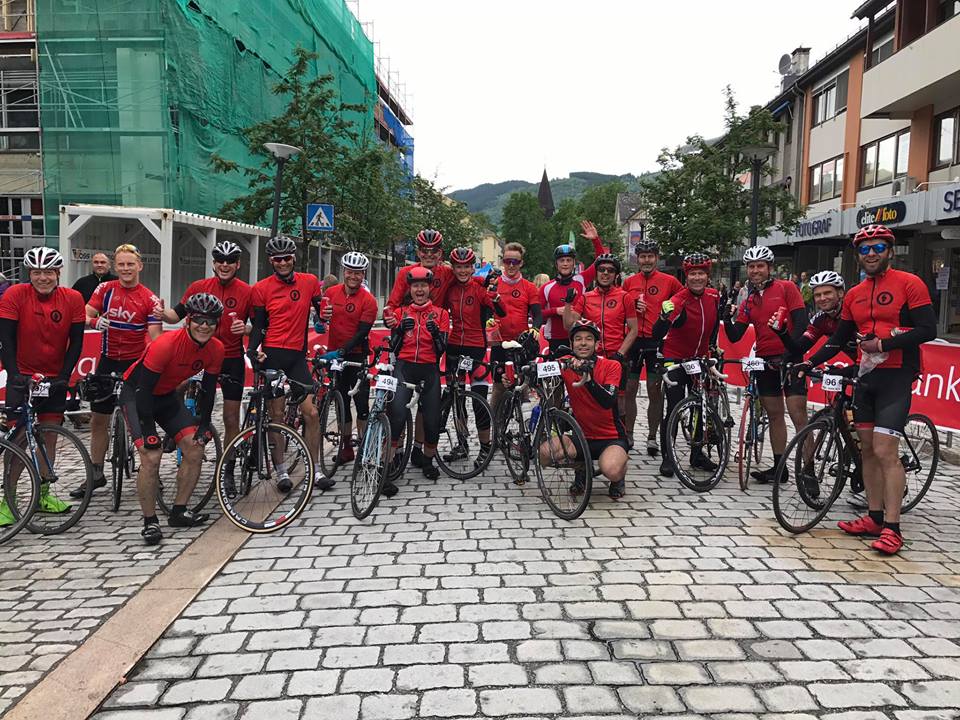
Mind you, I am not in these pictures. This time it is not about me, but about my friends in the extended group of Fjellgeitene (mountain goats) who biked the Bergen-Voss race as a group, and finished the 165 km course just below 5 hours, exactly as planned.

So what is the big deal about this, you might ask. And I must admit that, although I have been following their training with great interest, I hadn't realized the big deal. Last night, as announced, I was at the after-race party with them, and as the evening progressed it became clear to me what a wonderful story the whole project had been. It needs to be told!
A few months ago, Lars the chief goat put out an opinion poll asking who would like to try to bike the Bergen-Voss race within 4 hours and 59 minutes. Many people immediately signed up, and they ended with a big group who would go for this goal altogether. Now this might insult some of my friends, but I thought in my naiveness that this was an attempt for a new record for all the people in the group.  Only yesterday I realized that about half of the around 45 bikers in the group had already biked Bergen-Voss with finish times in the rage of 4h:15 and 4h:30!

So the whole project has been about 18 faster bikers helping 25 friends to make it below 5 hours! Wow, I was so moved this became clear to me. It is difficult to reproduce how the whole story slowly was revealed during the party last night, but it can be compared to watching a movie when you suddenly realize at some point that the story is something quite different than what you thought it was from the beginning. Like The Truman Show, or The Matrix, or Vanilla Sky, if you're interested in movies. If you haven't watched those movies, do it without reading the plot first. Then you will know exactly what I mean.
While we were eating, I had the pleasure of listening to Emil, who turned out to be one of the "locks". At that point I had no idea what a lock was, but it was extremely entertaining to listen to him, and I understood at least that he had a key role in the group, a kind of a connection between a front troop and the rest, shouting to people at the back when they should speed up not to loose contact with the front, what is coming ahead, when they should drink, when they can take it easy, etc etc. Already at that point I was moved by this wonderful caring for the rest of the group.

Later in the evening, Lars explained to me how the group worked during the race. First of all, they bike in a long line with two and two bikers side by side. In the front of the group are 16 fast bikers. Just behind those 16 are the two "locks", and then behind them come the rest of the group, called the "bus". The 16 fast bikers in the front take turns to go in the front and pull the rest. They do this in a natural rolling cycle, where some slow down slightly to fall behind and others take the lead. The locks (Emil and Bjarne) are the connection between the front and the bus. They constantly communicate with the back to tell them what is coming ahead, so that people are prepared and do not fall behind. At the same time, they also communicate to the front when difficult situations arise so that they should stay in their positions and stop rolling to take the lead.
Later during the night I learned how the project started. Last year, when Lars and several of the faster bikers in the front group achieved wonderful finish times at the Bergen-Voss race, they decided that next time they would help others to make it below 5 hours rather than chase their own personal records. So when he opened the opinion poll, people were already prepared and signed up immediately. This motivated many others, who were perhaps just at the border of being able to make it below 5 hours, to sign up as well, and in this was they created the biggest group of mountain goats ever to do the Bergen-Voss together.

Of course I should have known. Had I been more interested in bike racing, I could have checked the finish times from previous years, and I would have known that many of these people can do it much faster than 5 hours. I would then understand how so many people dared to join the group, and following the big "mountain goat express" project would have been more enlightening. But then I wouldn't have had the OMG experience of last night, which is comparable to any Oscar winning movie. And the beauty of it: not once during this spring did any of these guys ever post anything that could indicate that they are actually faster than the group goal of 4:59.... In light of how competitive these guys are usually, this is an unbelievably lovely example of kindness and sportsmanship. And maybe it is not that uncommon among bikers to do this, what do I know? In any case, my complaining about fast bikers: I take it all back!

I could write a whole book about Lars :-) (Maybe I will one day ;-) ) He is one of the most motivating and caring people I know, and I am so grateful to him in so many ways. Just as an illustration, here is a picture he posted when I was complaining about my slow progress in feeling safe on a bike.
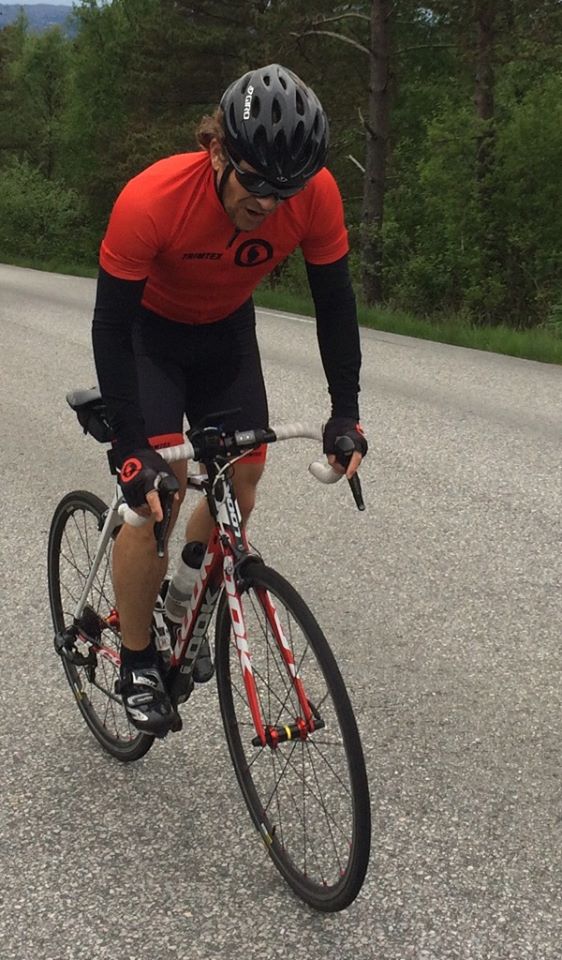
Here is how he looks now (definitely ready for the Tour):
Here is a much shorter and slower version of the mountain goat express:
I do not promise anything, but I can tell you: there is hope!

søndag 14. mai 2017

I want to ride my bicycle... or do I?

There are nine million bicycles in Bergen....

Or was it Beijing? At least it feels like that in Bergen right now! "Everybody" is preparing for the Bergen - Voss race, and they are all so fast...
I cannot make up my mind about whether or not I like biking as a training form. I remember when reading Haruki Murakami's book about running how much I agreed with him about the drawbacks of biking: your speed does not depend only on your strength and endurance, like in running. It depends on so many other things, like having a good and light bike, not being afraid of speed, whether you are good in maneuvering around all sorts of obstacles like people, kids, animals, and vehicles on your way... and the 9 million other bikers...
After experimenting a bit with triathlon, I was quite demotivated by the slowness of my heavy hybrid bike. So in winter Frank and I bought racing bikes. And the difference is indeed amazing. But it took me some time to get to the point where I could actually experience the difference. First I had to get past the obstacle of click pedals...
I knew that I would struggle with biking when the feet are locked to the pedals. I had tried this once a couple of years ago, fallen badly, and given it up. But now there was no way around it. During the winter, I put my bike on a stationary roller, and used it for restitution as often as I could. At the same time, I clicked my shoes on and off the pedals a million times to let it become natural. When the spring came, though, and we went for our first biking session outdoors, things did not work as easily as I hoped for. Just at the parking lot, before we even started, I fell twice trying to mount on the bike, and Frank and I were both wondering whether we would at all be biking that day. The thing is, unfortunately, it takes some falling before the brain realizes that it should very quickly unlock the correct foot before trying to set it on the ground. There is no help in soundly standing still with one foot on the ground, if you suddenly want to put also the other foot on the ground forgetting that it is still locked to the pedal. 
Of course things depend on earlier experiences. Although I could bike as a kid, it was never a natural part of my daily life. Growing up in a big city, we would take the bikes with us to a park and bike there. In contrast, Frank was biking daily as a kid, even participating in some small competitions. Even though I have biked more than him as an adult, his balance and confidence that comes from childhood is incomparable to mine. For him lock pedals were not a problem at all. After a couple of biking sessions, I was still feeling pretty insecure, and started to discuss whether I should go for another brand of lock pedals that some said were easier to click in and out of.  I discussed the matter with Knut Bøe, the legendary biker who now owns the bike shop we bought our bikes from (in fact I've discussed so many things with Knut, and we have been in the shop for advice and help so many times; he is an extremely inspiring and motivating person!), and concluded that I simply needed more practice.
 
So here I am now. Lock pedals are working fine; it has become natural to click in and out of them without thinking. Back/shoulder/butt aches from long rides are getting less and less painful, and more bearable. I still don't have the level of balance I would have liked. For example, slowing down during a race to get a bottle of drink offered and actually drinking and eating while riding still seem like distant dreams. But  as long as I have things to work on and improve,  I am somewhat motivated.
The problem is... I simply don't enjoy it that much. Oh, so there I've said it. Biking works perfect as recreation and restitution. But it is a pretty inefficient way of training to improve form. You need so many more hours than for running, you need free passage, empty roads, no people, no cars, and most importantly no other bikers. At least I do. I am so cautious that I slow down for people, cars, and especially unpredictable obstacles like kids and animals. But most other (faster) bikers don't. So there I am, slowing down in wait of an opening, and suddenly comes a fast biker and passes me and takes my opening before my path is again clogged with people. I know many of my friends won't like me saying this, but what I find among the biggest obstacles in improving my biking skills and increasing my enjoyment, are some of the fastest bikers out there.
Early Sunday mornings work fine. Before everybody else is out. Say from 8-11, you can get a lot of km done in peace and quiet, with as much speed as you dare. But here is only one Sunday a week... And I seem to be mostly motivated for this kind of commitment when I have an injury or pain that prevents me from running.
Oh well, we'll all see how it goes. It took me years to start enjoying running, so perhaps time is all that it takes. Once (if ever!) I have better balance and speed, and can join the group rides of Fjellgeitene, I am sure it can become much more fun.

And I am going to their after-party of the Bergen-Voss race!! :-D

mandag 1. mai 2017

Negative split at last! (Bergen City Halfmarathon)

Listen to your heart.... 

Yes, you know that all my training is about keeping the right heart rate these days, and little by little, it is giving more and more results. Just a quick recap of the recommendations (first from Mats and Christian, and then from Dag): all training happens either at zone 1 or at threshold heart rate, even the intervals. If anything happens in between, then it is progressive training where I start from zone 1 and work my way up to threshold HR, increasing speed at regular intervals. Already before the mentioned recommendations, I had started to not exceed the threshold heart rate, following the blog of Ingrid Kristiansen, but I was not good with zone 1 runs then. Now I have a lot of zone 1 in my training, not always by running but also by mountain hiking, swimming or biking. 
OK so what are the results? Not that they are very impressive (yet!) but still motivating: 10k PB in January, PB in the Fløyenkarusellen uphill race in February, my second best half marathon time ever in March, and PB of the Bergen City half marathon course two days ago. The improvements are small, mind you, but set into the following perspective, they are really uplifting: injury and no running in the whole of 2015, and falling behind of most my previous records during 2016. I am still VERY happy with 2016, as it gave me so many new experiences with a whole bunch of running buddies in Istanbul plus the euphoria of completing a marathon decently. But in 2017, I am finally catching up with myself of 2014! :-)
I won't bore you with the details of the race on Saturday, but I have some observations that I found interesting and that you might find helpful in your training. After the fitness test in March, Dag told me to start a long race well below threshold heart rate. On the other hand my threshold HR had fallen down to my zone 3, so I knew that there was no way to get a good half marathon time that way. So, three weeks ago I participated in a local, low profile half marathon just to test what I could do. I was not at all well rested for this race, but I managed to keep the pace I had decided beforehand very evenly until the end. The interesting part is that I was already at threshold HR from start, and after half way, although my speed was the same, my HR increased by about 10 beats. It was great to experience that I could go with much higher HR than I was told, and this helped me a lot during the Bergen City half marathon. For the first time ever in a race, I finally achieved negative split! My average pace was 10 seconds faster per km in the second half of the race compared to the first half.
I think the best way to become better at half marathon is to race more half marathons. In 2014, although I was faster in a sense, I did not at all have the same endurance as now. At that time, participating in a low profile half marathon that goes inside a forest was something I would not be able to motivate myself for. But now I can just join a race whenever I feel for it, without particular preparations, and this was actually my goal all the way from the start. When you race more, you get to know your body and your heart better, and you get to test how much you can push and when. My experience is that every half marathon feels easier than the previous, in fact quite pleasant. To keep the motivation throughout a race, I have acquired quite a few tricks which work really well for me:
Music. I just started with this recently, during the preparations for Amsterdam marathon. It was not easy to keep the motivation and the spirits high during the last long training runs, and I discovered how much better I felt when listening to music. My music list is very embarrassing, containing a crazy blend of old and new, oriental and pop songs, a complete mix of genres, but all fast and very rhythmic. Pick whatever works for you and try it out, especially if you have problems with motivation or losing speed during a long race.
Positive feedback. I find giving positive feedback to others during a race extremely rewarding. You get even more positive response back, and I always feel a rush of energy and increase of speed after such incidents. It is of course best if this comes naturally, but if not, perhaps you can even fake it until to you make it. ;-) I get very emotional during races, and whenever I see something or someone that moves me, I give a cheer, a clap, a thumb up, etc. This time, first it was the lady who was running inside a huge logo of the main sponsor of the race. I had read about her in the newspaper, but when I saw her at about the second km, I was surprised by how huge and impossible to run in her costume was. I clapped, cheered and gave her a thump up, and her response was invaluable! I repeated this whenever I felt for it: racers in wheelchairs, racers with strollers, slower marathoners who were still in their second round, ... Their response was so rewarding, and I immediately felt the increase in my speed. I was also fortunate to have many friends along the course who cheered me, Melkesyre with their kettle bells at the worst hill as always, Stian the world champ who ran with me along Fjellveien, Kari and Caroline who showed up surprisingly at unexpected places, and then the Melkesyre gang just 200 m before finish again. It helps, and it also proves that it's all in the head.
Nutrition. I always stop at every drink station. Whenever I did not do this it got back at me, so now I never skip one even if I feel good to go. About 200 m before a station I take a gel, and then I take two cups of water which also help clear my mouth and clean my sticky hands. Although one looses about 10-15 seconds by this (stopping means slowing down or walking), I think it pays off as better pace during the next few kilometers. At least for myself, I always feel a surge of energy and increased motivation after this. It is also a nice rewarding scheme; whatever the distance you are running, you can concentrate on the next drink station, promising yourself a short rest when you reach that point. It makes it easier to push when you have milestones.

Not exactly advice from an expert, but sometimes experiences of a peer might be more valuable than expert or elite advice. Last but not least: If you're struggling, don't forget that going easier on training might turn frustration into fun and improvement.

lørdag 25. mars 2017

Total decline

Numbers don't lie...
I have been implementing threshold training in a quite disciplined way during winter. However, the values I have based my training on were from a test I took in August 2014, so I wasn't entirely sure that I was actually training at correct intensity. This week I took a new test and got my lactate threshold and VO2-max values measured. Unfortunately, all values had gone down since 2014.
Good news first. Among the values that had gone down were also weight and fat percentage! :-) 2 kg lighter and 5 points less percent body fat compared to 2014, on the very same scale. My VO2-max had not changed much, around 52, which is still better than that of 99.5% of women my age, and better than even that of 96% of 20 year-old women. And the best news of all is of course Dag Hilland, the conductor of the test. It was so nice to see him again, get loads of information, motivation and advice. No matter how the results come out, the test itself is an incredibly rewarding experience, thanks to Dag. Both Dag himself, and not the least his wife Rebecca, have improved their forms impressively during the last few years, and Dag says it is all due to very disciplined threshold and zone 1 training. So I have been doing the right thing, but with a little too high HR than I needed to.
Not so good news. My heart rate zones are now quite a bit lower than what I thought. My zone 1 is really slow, and my threshold heart rate is about 7 heart beats lower than before. This corresponds to about 0.2 km/h slower speed at this HR. Recall that threshold HR is the point where your body starts producing so much lactic acid that you cannot keep going more than about an hour at that level. So this will have quite a bit to say for my half marathon time. Interestingly, the speeds that I can keep at various heart beats are still the same as before, but my body starts producing lactic acid earlier now than before.
To be honest, I was expecting this. But perhaps still hoping for better results. At the end of 2014 I was in really good shape, and then almost the whole of 2015 was characterized by injuries. Although I did a lot of uphill training and had a new record at Stoltzekleiven in 2015, there was almost no running, so my running form must have declined quite a lot during that time. Then in 2016 there was a lot of running but without paying attention to HR zones at all. It would have been nice to know where I was just before Amsterdam Marathon in October 2016. After that I lost a lot of form, and it is first recently that I started to feel some improvement again.
On the positive side. No matter what, it is good to know the real values and train accordingly in a dedicated way. Anyway my recurring injury in the hamstrings does not really make fast running much fun these days, so the slower zones fit me much better now. My new threshold zone is actually what I thought was my sweet spot, and it is quite pleasant to run in that zone, even for pretty long intervals or tempo runs (up to 10k). My new zone 1 is so slow that I can do it even when hamstrings and legs are complaining, and I can transfer some of my zone 1 training to biking and swimming, making sure to have even lower (10-15 heart beats) lower HR then. So in a sense, the new values will make my training easier and even more pleasant than before.
Boosted dedication. I have been reading everything I come across about threshold training, but there has not been a very clear single advice. I have been applying what Ingrid Kristiansen advises: never above threshold during training, only at competition. Dag's advice is very in line with this. Never ever train above threshold, not even during short intervals or uphills. The advice was very clear: a lot of zone 1 training, as much as you can get done. Then 2-3 times a week, training at threshold, either in form of intervals or a not too long tempo run. I must admit that although I was very careful about not exceeding (what I thought was) my threshold, I had not been doing much zone 1. My runs outside of threshold intervals were somewhere in between, and I have now adjusted all those down to zone 1.
Why threshold and zone 1 training.  Dag and Ingrid say that training at threshold has the same effect on your form as training at maximum heart rate. You train your heart to be stronger by pushing its current limits. If you instead train at maximum intensity, then the impact on your form will be the same, but you will wear down your body much more and accumulate a lot of lactic acid. You will need much more time for recovery so your total training volume will decrease. Keeping your intensive training to 2-3 threshold sessions a week allows you to train every day, as long as all your other sessions are in zone 1. Zone 1 training seems to do wonderful stuff to your body, your cells, your blood vessels, and your mitochondria (some tiny stuff in your cells that convert calories to energy). It also helps to keep you out of injury.
So I now have a clear recipe to follow and a lot of renewed motivation. But things are unfortunately still not so straight forward. My legs won't let me run as much as I want these days, so I have to resort to swimming and biking. I have no idea how this will impact my running form, but in any case I need this kind of triathlon training. I have also started seeing my physiotherapist Ane the angel again. Within my body's limits, I think I am doing everything I can.

The rest, I leave in the hands of the universe ;-)