Viser innlegg med etiketten Motivation. Vis alle innlegg

torsdag 30. august 2018

Ambassador's mission

When the going gets tough, the tough gets going!

Trondheim marathon is less than two days away! For the last couple of months I have been wondering whether I would at all be able to participate in any of the distances, but I have just signed up for half marathon and I am really really looking forward to it!
Things haven't been going as planned this year. After an incredibly successful 2017, I was perhaps a bit too ambitious in the beginning of 2018, and wore myself down with just a bit too hard training over time. As a result, I had to skip Bergen City half marathon at the end of April. But May was good; the weather was wonderful; I kept to the mountains and terrain, and at the beginning of June I was surprised by my performance at Bergen Fjellmaraton. You might remember all my good excuses during Fjellmaraton, one of which was that I fell and hurt my knees badly towards the end.
Although the knees were sore and stiff for a while, only nine days after Fjellmaraton I participated in a 27 km run from the center of Bergen to Knarvik. This race deserves a post on its own, which I never found time to write. It was such a wonderful experience, thanks to my friend Annbjørg who guided me through it helping me all the way. The race traverses over quite a few mountains,  and I was again surprised by my performance there. I took this as a good sign for the coming goal of running full distance at Trondheim marathon, feeling happy that my knees seemed already to have recovered after the fall.
Then during the summer holidays, I started slowly to increase my running distance with Trondheim marathon in mind. I was building up really cautiously, running only every second day, only one long run during the week, and the length of the long run only slowly increasing. Still a few weeks into this scheme, towards the end of a 24 km run my left knee started to hurt really badly. And after that I was more or less unable to run throughout the summer. Whenever I tried, it started hurting after a few km, so I simply stopped. The nice weather continued, so again I kept to the mountains and the terrain, and the knee started to get better, albeit very slowly.
A couple of weeks ago I started street running again, just to discover that my running form was completely gone. I gave up the Trondheim project totally. There is of course no chance of being able to run a marathon, as the knee is still not 100% yet. And my form did not motivate me to try a half marathon either. At some point I was considering 10 km, but then I found that it started too late in the day to fit the schedule of the rest of the family. So I was simply planning to skip the race, and just cheer for the others from the side line. Aksel, Frank and Annbjørg are going for the full distance, whereas a bunch of other friends from Bergen are doing the half marathon, and I thought I could at perhaps keep the marathoners company through the last 10 km and then cheer the half marathoners to the finish.
But then a friend suggested that I could help her achieve a half marathon PB. And that changed everything! The desired pace seemed doable for me without pushing my knee too much, although it would by no means be easy, given the lost form. Suddenly I had a new goal for the race, meaningful and within reach, and the motivation came back immediately! I am so grateful to her for this suggestion, and quite surprised by its effect on me. Still I had a small hesitation about whether or not the knee would survive 21 km...
On Wednesday I went for a 10 km run in the aimed pace for the race, both to test the knee and to test the form. Both seemed to be up to the challenge, and right afterwards I signed up for the race. After that I received yet another request of pace holding with the same finish time, so now I feel like a real pace holder. I really really hope I will be able to guide and motivate my friends in the right pace throughout the race. I am surprised to find out that this is actually even more motivating, exciting and fun task than trying to achieve a PB myself. And it fits so well with being an ambassador for the race. In fact, I've always dreamed of being a pace holder. Now I get to try it out, and perhaps I can volunteer to be an official one another time.

It's all about finding the right motivation!

søndag 6. august 2017

A few kilos off

Hard to get them off; even harder to keep them away...

I have been wanting to write this post since March, but I waited until now to make sure the kilos would stay away. During January and February this winter I made a serious effort and lost 6 kilos. Several friends have asked for the recipe and I promised that it would come. You might remember that I have a history of overweight, and I have to constantly watch what I eat, although i train several hours per day, in average.
At the time I lost the big weight all those years ago, I was told that it would take the body a couple of years to get used to the new weight. During this time the body would all the time try to get back to the same high weight again, so one had to be extra careful. Unfortunately, new research indicates that this period is much longer than two years. In fact, if the overweight lasted over a longer time, the body might try to get back to that weigh for many years, perhaps the rest of its life... Many of my friends keep telling me that I could eat all I want since my training volume is quite high. Unfortunately it doesn't work that way.

Although I found this pretty unfair in the beginning, I am now used to it. I know that I need to eat well to recover and to be able to train efficiently. I do actually eat a lot, but mainly vegetables, lean meats and whole grains. My one weakness is wine. I enjoy so much taking a glass of wine every now and then, but its effect on my weight is not good. It seems to block my system and make more trouble than the number of calories it contains. Still I manage to balance all these things with training, and for longer periods it all works pretty well. But a few hundred grams here and there might sneak in unnoticed every now and then, and suddenly in December discovered that I was about four kilos more than I was at the same time two years ago. Desperate that things would get worse during Christmas, and motivated by the fact that it was a low intensity time with respect to training and upcoming races, I decided to lose those four kilos and two more. And it worked! My goal was to lose 6 kilos until the end of February, and I made it just in time.
Losing a few kilos, when you are actually normal weight, is in some sense harder than to lose a lot of weigh when you are really overweight. First of all, you don't really need to lose that weight, so the motivation is naturally lower. For me, it was to be able to race faster. For others it might be to fit into some clothes that have become a bit too tight. Secondly, the first couple of kilos go pretty fast, and then you feel happy about yourself and relax and then everything goes back to start. Here are a few steps that helped me reach my goal:

 1. Do it with a friend. Both when I lost all that weight many years ago, and also this time, I did it together with friends in a similar situation. This time, one of my best friends who is also a runner, wanted to lose exactly the same number of kilos, and we were a great support for each other throughout the period. She also reached her goal at the same time, but on the way both of us would have down periods with lacking motivation. It was wonderful to be able to write to the other "I want to stop, I want to eat chocolate, I am hungry, I am fed up" etc, and get an uplifting, motivating feedback. Every Monday morning we would text each other with the weight of that day, and give each other kudos. We would also text many times during the week, especially when we were up to challenging situations.

In fact, for some reason most of us like to keep to ourselves about wanting to lose weight. But when you are open about it, you discover that you have many friends in the same situation, even surprisingly many men. I found out that a group of my male running friends also had a similar support group during the same time to lose approximately the same number of kilos. I exchanged with them experiences and challenges every time we met, and this helped me a lot to stay focused and motivated.
2. Write down everything you put into your mouth. This is actually the most important point. In my experience there is no other way to make it work. Since I was used to Grete Roede from my previous experience, I used their tools also this time. It works perfectly in Norway. They have almost everything that is available in the supermarkets in their web tool, you can choose from an easy menu, the calories come up automatically. The page also suggests a daily calorie intake for you, distributed to various meals, and calculates for you how well you are doing in different food categories. I know that there are many other similar pages. Many of them are free of charge and work perfectly. Just choose whatever works well for you.

3. Report your weight to some 'authority'. This works magics for me! During a Grete Roede course, you go on a scale once a week while the course instructor watches you. This time, I made a deal with Ketil, my dear friend and world's best personal trainer, that I would go on the Barry's Bootcamp scale every Tuesday morning at 8 am, just before our PT session. I made clear my goal for him, and the fact that I did not want to disappoint him made me more rigorous in my efforts, I think.
4. Be prepared that it will take time. Even if it's a few kilos, don't try to get them off quickly. If they go off quickly, then they will for sure come back soon enough. You don't need a quick diet and then you can go on on as before. You need to either change your habits, or remind yourself of your old good habits and get back into them. There are a few boosters that you might want to try, though. Like fasting (juicing). This is so healthy in so many other ways than just to lose weight, that I think it can be recommended. I did it twice during these 9-10 weeks, and both times it helped a lot both for motivation and to get things going again. It also teaches you to deal with hunger, and you realize after a couple of days that you can actually endure going a bit hungry every now an then.

5. Do regular strength training when you are losing weight so that you don't lose muscles, just fat.

So what about the end of the story? Did the 6 kilos stay away? Well most of them did. Two of them came back, so now I am back to where I was at the end of 2014 when I was pretty happy about my weight. After the holidays, though, I might still make an effort to get rid off those two again. In the end:

No matter what my weight is, there are always two kilos that I want to lose :-D

lørdag 29. juli 2017

How to avoid loss of form during the holidays

Unfortunately I am not able to give you the answer :-)
It’s the middle of holiday time, and my news feed is full of articles on how to avoid losing your form during the holidays. These articles usually have headings like “Holiday doesn’t necessarily mean that you have to give up on your race goal” etc, but the message inside tends to be more negative than the sound of the heading, encouraging you to run more and harder than what you probably would like to if you are at a hot place. Of course if your holiday is just one week or two long, there is nothing to worry about. I am pretty sure that such a break is fine, no matter how little or easy you choose to run. But my holiday is almost four weeks long at a place where running fast turns pretty impossible due to hot and humid weather, even at very early hours of the day.
This year, I should perhaps be worried about losing my form more than ever before. Although a fitness test I took in March suggested that my running form had declined since my previous test three years ago, 2017 has actually worked out pretty well so far. My goal has been to catch up with my form of 2014 and improve it, and I managed to beat Pinar of 2014 in every race that I participated this year.
Despite this, I am not that worried bout losing my form during the holidays. In fact, this is perhaps the most relaxed holidays I am having since 2014. It doesn’t mean that I am training or running less than in the previous three holidays. It’s just that I don’t think about it that much; it comes more natural, and it doesn’t cost that big an effort. Both in 2015 and 2016, I had signed up at a gym to do my strength training and to do some treadmill running during the holidays. This year, I am keeping it simple:  running in the very early morning about 4 times a week, swimming in the middle of the day 5-6 times a week, and doing a 30 min strength training session on the bedroom floor 5-6 times a week. I have also tried aqua running a few times; I find it pretty slow and boring, but I am hoping that it has at least the same effect as recovery runs.
But of course my running form will decline. I know it by experience. No matter how hard I try, it is not possible to keep up the volume and the speed in the heat. Previous years, I would try too hard sometimes, and still I would see no results. This year, I am simply applying my new rule: all running happens at either heart rate zone 1 or at lactate threshold heart rate. The holiday runs are pretty varied: intervals, slow runs, longer tempo runs, always starting out at zone 1, and never exceeding threshold heart rate (in fact nothing in between). The result is that my speed is much less here than at home. But still, I have so big confidence in this rule that I have high hopes of getting up my speed within a few weeks after the holidays. We will see; I will let you know.
I definitely owe much of the form improvement of 2017 to heart rate zone training. You might remember that I was complaining about a big loss of form after Amsterdam marathon. It took me so long to start feeling up to training hard again. Thanks to valuable advice from experienced friends I found the ingredients that could finally get me up and back on track. Dedicated heart zone training, a few kilos off, dairy-free diet, and supplements in preparation for the menopause are some the components behind my improvement in 2017. I have also participated in more competitions so far this year than before. I ran three half marathon street races in the first six months of 2017, which is the same number as I ran in total before 2017. And I ran several 10 km races, which I never did before. Keeping the training at a manageable pace (never above threshold), and rather concentrating the hard efforts around competitions, is an advice that I have tried to follow conscientiously, and I think it has worked out for me.
Mind you, my improvements are not that spectacular. To give an idea on my 2017 PRs: 30 seconds in the Fløyenkarusellen 2.5 km uphill race, 1 minute at the Fana 10 km street race, 2 minutes at half marathon, 4 minutes at mountain half marathon, etc. As a comparison, my friends are improving by far more minutes than me. But after a year of injury (2015), and a year (2016) of frustration of not being able to get back to my 2014 form (although I had some really nice achievements in 2016, like competing a full marathon in a decent time), it feels great to finally start getting better than before again.
Have I found the perfect training scheme? No. There are so many more things that I want to do, which I find hard to find time or motivation for. I want to get better (read: feel safer) in biking. After the holidays, I have two important races coming up: Stoltzekleiven at the end of September and Oxford half marathon in the beginning of October. It will be tough find time to train in such a way that I can get a new PR in both. And, if I manage to do so, I cannot imagine that there will be much time for biking. But hey! The reason for all this is to have fun, I remind myself! So, do the training that gives you the best pleasure and that you find the most motivating and rewarding at the time. There will be time for the other stuff at some point. When form in one discipline improves, it is nice to push it. When improvement gets hard to obtain for some reason, it could be motivating to try something new.
Enjoy your holidays, take it easy, and don't forget to have fun!

søndag 11. juni 2017

I take it all back: fast bikers, you rule!

Last night I witnessed one of the nicest, most inspiring, and incredibly touching pieces of sportsmanship. And it is all about biking!
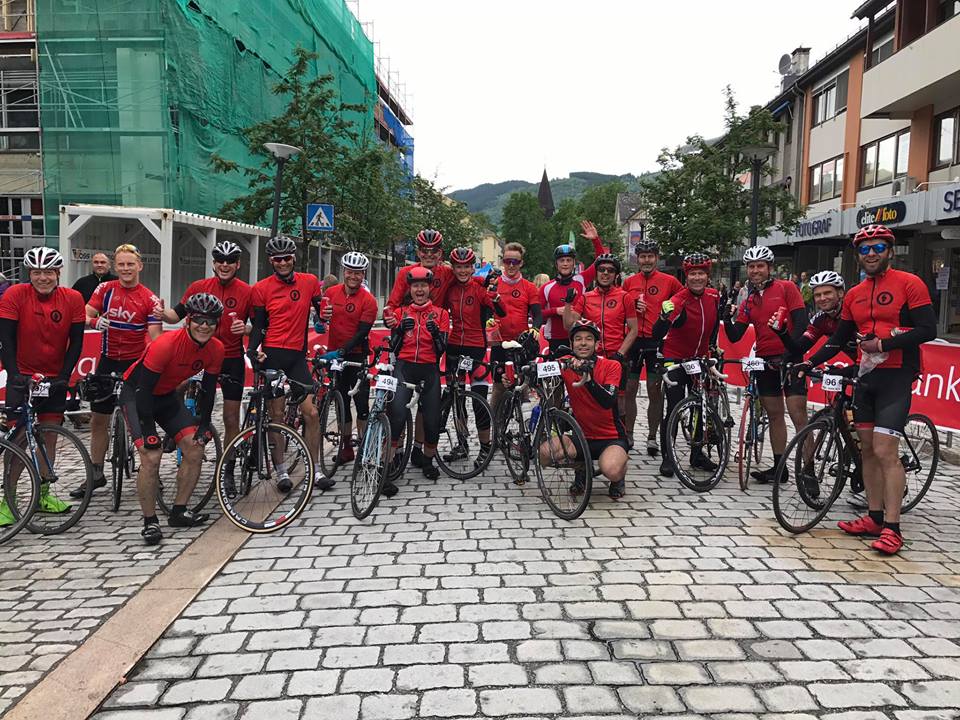
Mind you, I am not in these pictures. This time it is not about me, but about my friends in the extended group of Fjellgeitene (mountain goats) who biked the Bergen-Voss race as a group, and finished the 165 km course just below 5 hours, exactly as planned.

So what is the big deal about this, you might ask. And I must admit that, although I have been following their training with great interest, I hadn't realized the big deal. Last night, as announced, I was at the after-race party with them, and as the evening progressed it became clear to me what a wonderful story the whole project had been. It needs to be told!
A few months ago, Lars the chief goat put out an opinion poll asking who would like to try to bike the Bergen-Voss race within 4 hours and 59 minutes. Many people immediately signed up, and they ended with a big group who would go for this goal altogether. Now this might insult some of my friends, but I thought in my naiveness that this was an attempt for a new record for all the people in the group.  Only yesterday I realized that about half of the around 45 bikers in the group had already biked Bergen-Voss with finish times in the rage of 4h:15 and 4h:30!

So the whole project has been about 18 faster bikers helping 25 friends to make it below 5 hours! Wow, I was so moved this became clear to me. It is difficult to reproduce how the whole story slowly was revealed during the party last night, but it can be compared to watching a movie when you suddenly realize at some point that the story is something quite different than what you thought it was from the beginning. Like The Truman Show, or The Matrix, or Vanilla Sky, if you're interested in movies. If you haven't watched those movies, do it without reading the plot first. Then you will know exactly what I mean.
While we were eating, I had the pleasure of listening to Emil, who turned out to be one of the "locks". At that point I had no idea what a lock was, but it was extremely entertaining to listen to him, and I understood at least that he had a key role in the group, a kind of a connection between a front troop and the rest, shouting to people at the back when they should speed up not to loose contact with the front, what is coming ahead, when they should drink, when they can take it easy, etc etc. Already at that point I was moved by this wonderful caring for the rest of the group.

Later in the evening, Lars explained to me how the group worked during the race. First of all, they bike in a long line with two and two bikers side by side. In the front of the group are 16 fast bikers. Just behind those 16 are the two "locks", and then behind them come the rest of the group, called the "bus". The 16 fast bikers in the front take turns to go in the front and pull the rest. They do this in a natural rolling cycle, where some slow down slightly to fall behind and others take the lead. The locks (Emil and Bjarne) are the connection between the front and the bus. They constantly communicate with the back to tell them what is coming ahead, so that people are prepared and do not fall behind. At the same time, they also communicate to the front when difficult situations arise so that they should stay in their positions and stop rolling to take the lead.
Later during the night I learned how the project started. Last year, when Lars and several of the faster bikers in the front group achieved wonderful finish times at the Bergen-Voss race, they decided that next time they would help others to make it below 5 hours rather than chase their own personal records. So when he opened the opinion poll, people were already prepared and signed up immediately. This motivated many others, who were perhaps just at the border of being able to make it below 5 hours, to sign up as well, and in this was they created the biggest group of mountain goats ever to do the Bergen-Voss together.

Of course I should have known. Had I been more interested in bike racing, I could have checked the finish times from previous years, and I would have known that many of these people can do it much faster than 5 hours. I would then understand how so many people dared to join the group, and following the big "mountain goat express" project would have been more enlightening. But then I wouldn't have had the OMG experience of last night, which is comparable to any Oscar winning movie. And the beauty of it: not once during this spring did any of these guys ever post anything that could indicate that they are actually faster than the group goal of 4:59.... In light of how competitive these guys are usually, this is an unbelievably lovely example of kindness and sportsmanship. And maybe it is not that uncommon among bikers to do this, what do I know? In any case, my complaining about fast bikers: I take it all back!

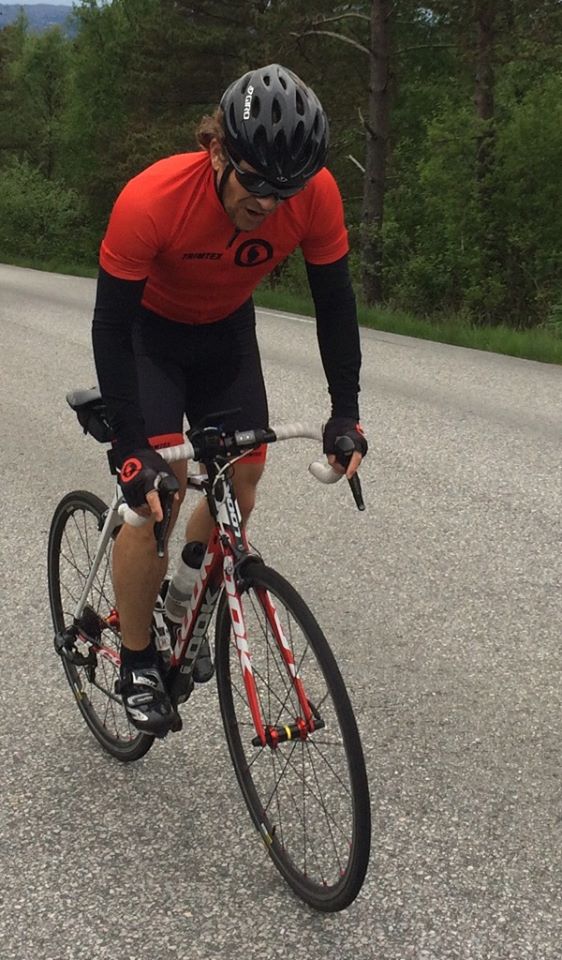
I could write a whole book about Lars :-) (Maybe I will one day ;-) ) He is one of the most motivating and caring people I know, and I am so grateful to him in so many ways. Just as an illustration, here is a picture he posted when I was complaining about my slow progress in feeling safe on a bike.
Here is how he looks now (definitely ready for the Tour):
Here is a much shorter and slower version of the mountain goat express:
I do not promise anything, but I can tell you: there is hope!

søndag 22. januar 2017

Going vegan or going hungry?

An apple a day keeps the doctor away...

Last blog post received so many interesting comments that I wanted to continue a little bit more on the nutrition thread. During the Christmas break, I stumbled upon a few programs on BBC tv. The one program was about the benefits of vegan lifestyle, and the other was about how fasting for 24-72 hours every now and then can be beneficial for your health. The indications were so strong that I got really curious about both. But I also have some questions that I haven't found the answers to.
Fasting
Now let's start with this one, since I do in fact have some experience with this. Three times, during 2014 and 2015, I completed a three-day juice program. At that time, I did it mainly for weight management, but now I have learned that the benefits are so much more. In fact, the 2016 Nobel Prize winner in medicine and physiology, Yoshinori Ohsumi, got the prize exactly because of his research showing the benefits of hunger on the renewal of human cells.  The bottom line of the story is that when we go hungry (less than 500 kcal a day) for 1-3 days, the growth of new cells in our body slows down, and instead the body starts repairing existing cells. For a person with high cholesterol and blood pressure, such a diet can reduce the values to normal, even just after fasting once (then you have to do it every now and then to keep the good effect). Even for healthy people, this process is documented to slow down aging, and it might cancel or postpone the risk of serious diseases.
  
Vegan diet
The benefits of vegan diet seem to be very comparable to the benefits of fasting. Animal protein is one of the foremost promoter of the growth of new cells in our bodies. The production of new cells is good when we are young, but as we get older it also means quicker aging. Vegans, in average, not only live longer, but they also age better. Meaning that they stay healthy and young looking until very old age. Vegans are also in average slimmer, they almost never suffer from heart strokes, and there is a lower occurrence of cancer among them.
The benefits of going hungry or going vegan seem to be endless. And since benefits of both methods seem pretty similar, we can probably choose which one we would like to apply, if any. If the idea of going hungry a day or three every now and then (it is really not that difficult) seems doable, perhaps that is easier for you than to change your whole diet. Or perhaps anyways you have reduced animal products quite a lot, and the way to a vegan lifestyle is not so long. I must admit that I got inspired to try another juice program; I'm starting already on Monday!
Now, let us be more critical. Of course if you compare vegan lifestyle or periodic fasting to "normal" unhealthy eating habits (yes, unfortunately normal - meaning average - eating habits are unhealthy), the benefits are huge. But what if you are, like me, a person who is quite careful about what you eat, and avoid unhealthy fats, sugar, white flour, starch, prefabricated foods, and fried foods? What if your diet already contains a lot of vegetables and otherwise consists of fruit, lean meats, whole grains and nuts? Unfortunately I could not find any studies that compare such a life style with that of a vegan. One of the arguments used by vegan sites is that our ancestors did not eat meat or animal products. But we live longer today than our ancestors, and our brains have evolved a lot since their times. Could this be due to animal products? And how about athletes who want to improve running form or body strength? Are we not dependent on muscle growth?
I am sure both "sides" of the debate can give convincing answers to my questions one way or the other. While I was thinking about these things, I ended up watching another program on Norwegian NRK tv, this time, about areas in Europe where people live longer and stay healthier than the average European. Now, these places had very little in common in their diets. Toulouse in France (lots of duck, blue cheese and red wine), Iceland (almost no vegetables, lots of dried meat, fresh fish), and a small place in Italy (lots of olive oil, vegetables and fresh made pasta). The conclusion of the researchers was that there might be some components in these diets that are balancing out each other. However, they had one thing in common: almost no industrially processed foods.

What seems to be sure is that average European diet nowadays contains too much meat and animal products, and too much processed or prefabricated food. So, even if you don't want to go vegetarian or vegan, cutting down on meats and animal products is definitely a good idea. Avoiding processed and prefabricated foods (instant soups, sauces, cereal, packed snacks, etc) is probably even more important. Fasting a day or three, a few times a year, especially on resting days when you are not planning heavy exercise, can also be a good component to add to your routine.
For myself, I am inclined to continue with my dairy-free diet. I am enjoying it more and more, and it is surprisingly easy. I feel light and energized, and my form is actually improving. I have also discovered how much calcium there is in green vegetables, especially kale! I have calculated that I get more than enough of calcium without any dairy. So I was probably getting too much calcium earlier. That might also be a slow down of form, I have read. On top of my dairy-free diet, I am eating more fish and less meat, and I have almost stopped eating chicken. A couple of times a year, like after Christmas and after summer holidays, I might do a three-day juice program, to balance the effects of junk food and too much wine ;-)

Say yes to new adventures! (Better an "oops" than a "what if"...)

søndag 2. oktober 2016

Marathon training III : Keeping up the motivation until the end

Through pain and frustration. Through rain and wind...
Thursday evening Frank and I went for a 14 km tempo run. There was a storm outside. We waited as long as we could for the rain to stop, but it simply got worse and worse, and in the end we just went. We got really soaked, the wind was against us no matter which direction we ran, and despite the high effort, we were pretty cold the whole time.
What gives the motivation to go ahead with such a session? For me, it was the fact that I had not run the day before, and practice for the rest of the week was tightly scheduled due to work and family obligations. So if I skipped that run, there would be no chance to do it another day and I would loose one more practice before Amsterdam. These days I am loosing a lot practices compared to my program already, so I simply could not afford to miss that run.

I cannot train as much as would like to, as various parts of my body (yes, there are more now than just the hamstrings) let me know very clearly when they advise me to skip a day of running. And having learned the hard way, I do listen to these body parts, and take it easy when things start acting up. I try to calm them down with ice and compression, and after a day or two, I try to catch up with the training when they let me.
It is quite demotivating be unable to train to be at your best. On the other hand, perhaps my body can never take marathon training more than this level, and in that sense this is as good as I can get. Although my lungs and muscles would have managed more, my tendons are holding back. From time to time, I do really want to give up the whole idea of running a marathon. It happens that I am so worried about possible injuries and lacking performance that  I have trouble sleeping at night, which again affects training performance. Doing bad at training adds to the stress about the race, and it all becomes a vicious cycle....
But then comes a good practice where I feel fast and strong, and it wipes away all the frustration, and I feel wonderful again. So, how do I manage to pull myself up and get going again so that the good practice actually happens? I don't know, to be honest. I think it is a bit like how I motivate myself to finish a long run. Just think one small portion at a time, concentrate on the next task, adjust myself to the situation, and go on as best as I can.
Because this is exactly how it is during a long run. Some friends ask me how it is possible to do these long runs of 30 km or more once a week. I must admit I find it hard. The first time I had a run that was longer than a half marathon was in Istanbul in June. I ran 24 km all alone. It was hot, but I had planned the whole thing very carefully in my head. I would reward myself at some milestones. I knew that there was a gas station at 6 km and at 12 km, so I promised myself to stop and have a cold drink at 6, 12, and 18 km, as well as a big breakfast at the end. Then, during the run, I only needed to concentrate and motivate myself until the next stop. It worked pretty well, and since then I applied it to all the longer and longer runs.
Of course running with a group of friends helps a lot. But my friends whom I am training for the marathon with are all faster than me, and although Frank always runs back and forth to never leave me all alone, I end up running half the distance by myself. (Which is good practice actually, as I will be on my own during the race as well.)  So I still look forward to the stops. There are always three stops: after 1/4 of the distance, then at half, and then at 3/4. I only think until the next stop and try to ignore rest of the distance. Before every stop I feel exhausted, but after taking a gel and some water I am good to go for another round. I hope this will help me during the race itself as well. I will try to concentrate on one water station at a time.
Sometimes I wonder whether I started to prepare this training a little too early. Who knows? Just a month ago, I was painfree and feeling wonderful and excited about the race and about my performance possibilities. So if I had started my marathon training a month later than I did, perhaps I would be at my best now? We cannot know. Some of my much faster and more experienced friends got injured during taper time just before a race, after completing a their training program successfully. Whereas others are training hard, getting better, and having a great time looking forward to the next race. There is no correct answer that fits all. The most important thing is to not compare oneself with others.

Although it is a race, it is not a competition with anyone else than myself.